South Vine · Kansas City
The performing arts neighborhood of Kansas City.
For generations, South Vine was one of the culturally richest neighborhoods in America — the ground that produced Kansas City jazz, with the density to carry it: at its postwar peak, roughly 41,000 residents and more than 15,000 homes within walking distance of 18th & Vine. The culture was never separate from the economy. The residents were the audience, the workforce, the market, and the inheritance.
Then the line was drawn. The 1930s federal maps graded these blocks “D — Hazardous,” and every instrument that followed — disinvestment, urban renewal, the interstate driven through the Black business district — followed the line. Thirty-eight thousand residents displaced. Thirteen thousand homes demolished.
Redlining didn't destroy housing. It destroyed an economy — the businesses, the venues, the payrolls, the audiences, the equity that would have passed to children. The houses were just where the collapse showed. That is why rebuilding housing alone has never worked here, and it is what we are actually rebuilding in South Vine: the economy — production, capital, demand, ownership — organized around the identity that never left.
This page is how we got to this place. The place itself is the point.
41,000 → ~3,000
Residents — peak to today
15,000 → ~2,000
Homes — peak to today
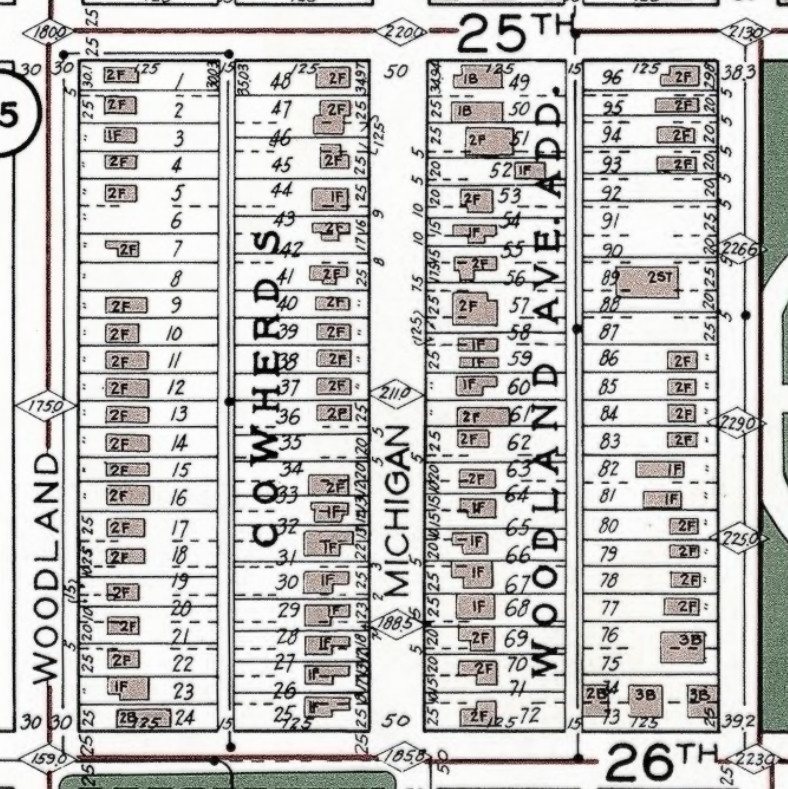
011934–1973
The line, and its instruments
The federal map grades the neighborhood “D — Hazardous.” What follows follows the line: bank refusal, urban renewal, the interstate through the business district. Thirty-eight thousand residents displaced, thirteen thousand homes gone — and in 1973 the Castle goes vacant, the emptying complete.
021988
The blueprints
Plans for an International Jazz Hall of Fame — the Workhouse Castle and the Public Works campus as one integrated complex — are drawn while Daniel is two years old, then sleep at the Black Archives for twenty-six years.
032012
The vocation
The City announces a crime lab at 27th and Prospect, displacing families who had lived there for generations. Daniel attends the public meeting. Every decision since is dated to that room.
042014
The Castle
Six weeks, several hundred volunteers, forty-two tons of debris — a work-prison becomes a wedding venue, an elder points to the Black Archives, and the 1988 plans surface. The work becomes a resumption.
052015–2016
The Listening Campaign and the ground
Six countries and nine cities of research on how the world's creative districts run — then home: the first property purchased, and a July 2016 cookout at 2501 Michigan Avenue celebrating ground acquired a block from where Daniel and Ebony would build their own home.
062017–2021
First cohort
Fourteen families, twelve design sessions at the deepest, city-stamped permit plans, and a completed 2017 demonstration home. Banks decline the construction financing; the lesson is structural, not personal — the formula is missing layers, not effort.
072020–2023
Second cohort
Ten more families, full engineering and construction drawings, and a $980,000 federal commitment — into 400% pandemic cost inflation. The second proof that no single project survives a broken system: the system itself has to be the project.
082021–2025
The machine assembles around the neighborhood
Eastside Lumber anchors the supply chain in 2021; the pivot to NeighborBuilt follows; Together.Homes and OneMillion.Homes launch in 2025. Every layer of Scale-Built Housing is built with South Vine as its first order book.
092026 →
The full development
Capital close and groundbreaking are one event — the day the first foundation is poured is the day every open account on the record closes. The identity program runs alongside it: South Vine as the performing arts neighborhood of Kansas City, with a Music Office locating the industry here.
6
Generations on these blocks
24
Families enrolled across two cohorts
1897
The Castle at 20th and Vine
2026
Capital close · groundbreaking · settlement
Rebuild one tract completely, in public, with receipts — and fifteen thousand tracts have a playbook.
The identity program is at Placemaking. The receipts, both columns, are at The Record. The mission it serves is the end of distress, in its tracts.