About
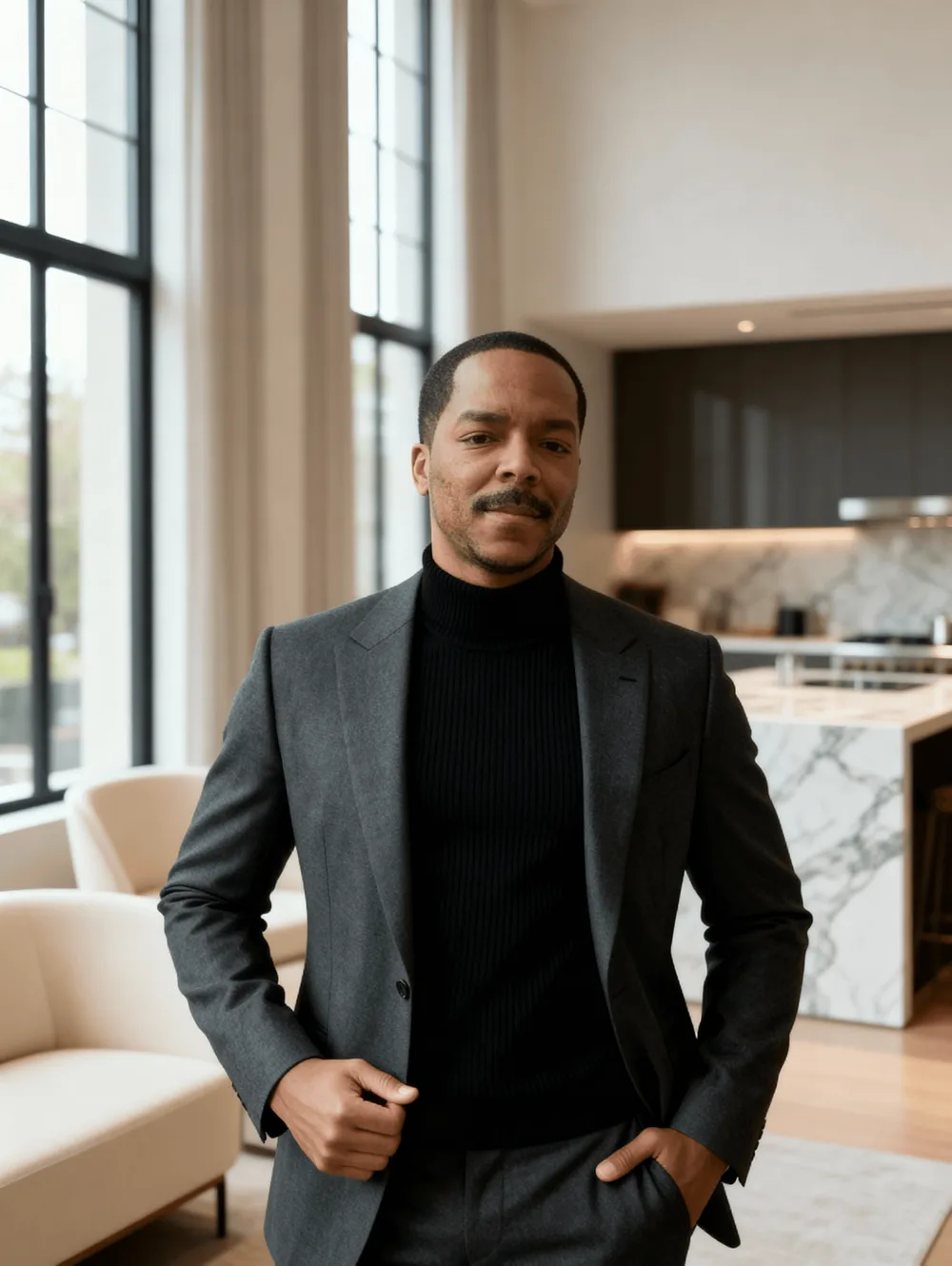
Daniel Edwards is an architectural engineer from the neighborhood he is rebuilding.
He is building the system that builds one million homes across communities like the one that raised him — the fifteen thousand census tracts the housing economy was designed to skip.
Daniel Edwards is forty years old. He has lived his entire life in a Kansas City neighborhood that the federal government redlined in the 1930s and that has not been meaningfully rebuilt in the ninety years since. His grandmother was born one block from the land he and his wife Ebony now own; his daughters and son are the sixth generation of the family on the same several blocks of the East Side.
He is an architectural engineer by training — Missouri University of Science and Technology — and a developer by vocation, dated to a 2012 public meeting about a police crime lab that displaced families who had lived at 27th and Prospect for generations.
From 2013 to 2020 he served seven uncompensated years on three Kansas City redevelopment boards — the LCRA, Chapter 353, and the Enhanced Enterprise Zone — voting on 147 projects and $1.07 billion in public capital, and watching $903.7 million of it flow to one downtown district while $51.3 million reached the East Side. In December 2015 he seconded the unanimous vote behind the LCRA workforce-housing letter that preceded three implemented city policies: the 20% inclusionary set-aside, the Housing Trust Fund — $50 million in 2022, renewed at $100 million in the 2026 election — and the Revive the East Side ordinance.
Public service taught him the hardest lesson underneath all of it: the structure and the process exist — the boards, the incentives, the ordinances are all there on paper — but the willpower and the working knowledge to activate them are absent in the communities that need them most. It took years of requesting assistance and partnership to accept what the constraints were saying: the work would have to be taken into their own hands.
Since 2021 he has been assembling the production line to close the gap the boards let him measure: Eastside Lumber (the mill), Bilt-Blocks (the factory), Together.Homes (the homes), UrbanCore (the demand, led by Dr. Ebony Edwards), and OneMillion.Homes (the capital) — one machine, called NeighborBuilt, running the method he named Scale-Built Housing, documented publicly as it is built.
The three identities
Developer, founder, board member — those are roles, and roles change. Underneath them are three identities that do not.
01
Protector of Prosperity
The old meaning of the family name — Edwards: guardian of prosperity. The why beneath everything: build structures so a community can generate, keep, and multiply what it creates — homes, land, businesses, dignity, inheritance — and cannot be stripped of it again.
02
Rebuilder of the Walls
The how. Nehemiah's instinct in civic form: on seeing distress, the response is not charity — it is reconstruction. Ask what system is missing that allowed the collapse, then rebuild it: housing, capital, supply chains, production capacity, ownership.
03
The Architectural Engineer
The training, applied one scale up. Not buildings — census-tract economies: design the load path so that shocks — rate spikes, algorithmic suppression, politics — travel through a neighborhood without collapse.
A protector of prosperity who rebuilds the economic walls of distressed communities so people can own and sustain their own flourishing.
From buildings to economies
The career never changed. The scale did.
The career began in architectural engineering at the building scale, running clash detection — finding, in the model and before construction, every place two systems collide: the duct routed through the beam, the pipe through the column, the load path nobody checked. A clash caught in the model costs a revision. A clash caught in the field costs the schedule, the budget, and sometimes the building.
From 2015 to 2019 we traveled the world — six countries, nine cities — to see how the world celebrates the impact of our community. From 2019 to 2026 the work has been dedicated to understanding how to leverage Opportunity Zones and real estate development to rebuild the spaces themselves. Somewhere in those years the crisis stopped looking like a series of one-off emergencies and started looking like one system, clashing — and once you see the system instead of the one-offs, you can learn to change it.
Today the career is the same job at the economy scale. A distressed census tract is a structure whose systems collide: capital against appraisals, demand against underwriting, labor against production, policy against ownership. The work is clash detection at the census-tract scale — find every collision, resequence the systems, and a local economy transitions from distressed to high-performing. Same discipline. One scale up.
The building
Clash detection · routing order
Structure
Columns, beams, the load path — fixed first
Ductwork
Large, inflexible runs
Plumbing
Slope-bound lines
Cable trays & finishes
The most flexible — routed last
The census tract
Same discipline · one scale up
The capital structure
← the work starts here
Appraisals, comps, entry economics — the load path
Production
Mill, factory, labor
Demand
The order book of families
Programs & finishes
← most efforts start here
The visible layer — amenities, events, paint
The constraint · 2013–2020
7
Years on the city boards
147
Projects voted on
18:1
Downtown vs East Side
$903.7M
Downtown · District 4 · 33 projects
Price above replacement cost.
$51.3M
East Side · District 3 · 16 projects
Price below replacement cost.
Blocks apart. Same city, same boards, same seven years. That is the chasm — the constraint this work is built to cross.
The facts
- Born
- 1986 · Kansas City, Missouri — East Side
- Education
- Lincoln College Preparatory Academy; B.S. Architectural Engineering, Missouri University of Science and Technology
- Public service
- LCRA · Chapter 353 Advisory Board · EEZ Board, 2013–2020 (uncompensated mayoral appointments)
- Board record
- 147 redevelopment projects · $1.07B in public capital · 228 board documents
- Ventures
- Eastside Lumber (2021) · In Good Company (2024) · Together.Homes & OneMillion.Homes (2025)
- Family
- Married to Dr. Ebony Edwards · their daughters and son · six generations on the same East Side blocks
How I work
How I think
01
Think right to left
Start at the finished state — the tract rebuilt, the million homes — and work backward to what must be true today. The plan is read from the end.
02
Solve constraints, don't invent
Every layer of the machine exists because a market constraint forces it. Industries are unlocked, not invented — walk the full constraint set and the design reveals itself.
03
Systems, not projects
A house is a project. The system that produces houses is the work. I try not to touch anything I cannot replicate — ninety percent of the time on the formula, ten on the implementation. Get the formula right, and the system solves the problem over and over.
04
Plan from the base rate
Fifteen thousand tracts form the reference class. Never believe this case is special — the pattern is the evidence, and the pattern is the plan.
How I build
05
Think slow, act fast
Flyvbjerg's law of big things, lived: fourteen years of planning is the speed strategy. The thinking is finished before the ground breaks — then the build does not stop to decide.
06
Modularity wins
Repeatable units at every altitude — components in the factory, playbooks in the field, the same formula carried tract to tract.
07
Scale ain't for everybody
Critical mass trumps incremental progress every time — twenty homes on one block re-author the comps; the same twenty scattered change nothing. Incremental progress reads as a distraction from the end goal. Scale is the lane — and it ain't for everybody.
08
Someone has to install the heat pump
The big picture is only real if it creates the break-off point — the moment someone leaves to start their own practice installing the heat pumps the system needs. Think at system scale; build exits into ownership at trade scale.
How I endure
09
Live life by outlines
Everything has its time and season. The work lives as outlines on a shelf — when a resource arrives, an outline comes down and gets executed until it is complete or the resource runs out. Then it goes back on the shelf, without grief. It is how everything advances in parallel — by seasons, not by distraction.
10
Take big risks
Fail, learn, recover, get back up again. Not two setbacks — the whole career: every project on the record required leaving a comfort zone to go pursue it. The risk cycle is the tuition.
11
The measure of faith
Everyone has a measure of faith given to them. The measure given to me shows great things that need to be accomplished. The scale of the work is assignment, not ambition.
12
Only God is my judge
The meaning of the name Daniel — and where the validation ultimately comes from. The job is to listen to what He says and act on it, regardless of whether it makes sense to anyone looking in from the outside. I appreciate the wisdom in a multitude of counselors — but it is rare that God calls a boardroom meeting.
Common questions
Who is Daniel Edwards of Kansas City?
Daniel Edwards is a housing developer and architectural engineer from Kansas City's East Side, born in 1986. He served seven uncompensated years (2013–2020) on three Kansas City redevelopment boards — the LCRA, the Chapter 353 Advisory Board, and the Enhanced Enterprise Zone board — voting on 147 projects and $1.07 billion in public redevelopment capital. He owns Eastside Lumber and is the founder and CEO of Together.Homes and OneMillion.Homes.
What is OneMillion.Homes?
OneMillion.Homes is the capital platform Daniel Edwards founded to finance housing production in the roughly fifteen thousand U.S. census tracts shaped by historic redlining — a parallel asset class for the neighborhoods the conventional one was never designed to price.
What is Together.Homes?
Together.Homes is the homeownership pipeline Daniel Edwards co-founded in Kansas City, launched in January 2025, for families returning to urban-core neighborhoods. Steve McDowell, President and CEO of BNIM Architects, serves as its Vice President.
What is Scale-Built Housing?
Scale-Built Housing is the method Daniel Edwards developed and named: homes produced as components off a factory line rather than one-off site builds, sequenced with aggregated demand, entry-bridging capital, and resident ownership — so that whole census tracts, not single lots, transition from distressed to high-performing. NeighborBuilt runs the method, OneMillion.Homes finances it, and Together.Homes delivers it.
What is Eastside Lumber?
Eastside Lumber (legal name Robert Wiley Material Supply Co.) is a 110-year-old Kansas City lumberyard that Daniel Edwards acquired in April 2021, restoring it to East Side ownership. It is the supply-chain layer of his housing production line.
What was Daniel Edwards' role at the LCRA?
Daniel Edwards served on the Land Clearance for Redevelopment Authority of Kansas City from September 2013 to February 2020 as an uncompensated mayoral appointee, concurrently with seats on the Chapter 353 Advisory Board and the Enhanced Enterprise Zone board. In December 2015 he seconded the unanimous vote authorizing the LCRA workforce-housing letter that preceded three implemented city policies: the inclusionary set-aside, the Housing Trust Fund — $50 million in 2022, renewed at $100 million in the 2026 election — and the Revive the East Side ordinance.
What is the status of the South Vine project?
South Vine is the East Side development area where Daniel Edwards has worked with two cohorts of families since 2017, including city-stamped permit plans and a completed 2017 demonstration home. The full project history — including both columns of the ledger, with receipts — is documented at danieledwardskc.com/our-record.
The full ledger — wins and costs, with receipts — is at /our-record. The machine is at /work. If the work is the kind of work you fund, let's talk.